
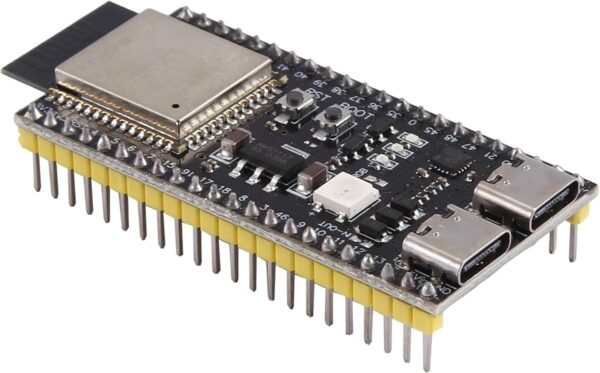
ESP32-S3 DevKitC-1 N16R8
₨ 1,870
ESP32-S3 development board with 16 MB flash and 8 MB PSRAM, dual-core 240 MHz, Wi-Fi and Bluetooth 5 (LE), and two USB-C ports.
Overview
A DevKitC-1-style development board built on the ESP32-S3-WROOM-1-N16R8 module. The 16 MB flash and 8 MB PSRAM leave room for large firmware, web interfaces, camera and display frame buffers, audio processing and machine-learning experiments.
The dual-core Xtensa LX7 processor runs at up to 240 MHz, with 2.4 GHz Wi-Fi and Bluetooth 5 (LE) built in. One USB-C port connects through a USB-to-UART bridge for programming and serial monitoring; the other connects to the ESP32-S3's native USB for USB device and OTG use.
Key Features
- ESP32-S3-WROOM-1-N16R8 module: 16 MB flash, 8 MB octal PSRAM
- Dual-core Xtensa LX7 up to 240 MHz, 512 KB SRAM
- 2.4 GHz Wi-Fi and Bluetooth 5 (LE)
- Two USB-C ports: USB-to-UART and native USB/OTG
- BOOT and RESET buttons, onboard RGB LED
- Pre-soldered 2.54 mm headers for breadboard use
Typical Applications
- IoT devices and Wi-Fi dashboards
- Camera, display and touchscreen projects
- USB HID devices such as custom keyboards and controllers
- Audio and voice projects
- Machine-learning and sensor-fusion experiments
Compatibility
Programmable with ESP-IDF, the Arduino IDE (ESP32 board package), PlatformIO and MicroPython. Select a board profile with 16 MB flash and octal (OPI) PSRAM to use the full memory.
Important Notes / Safety
- The GPIO pins are 3.3 V logic and are not 5 V tolerant. Use level shifting for 5 V modules.
- Some GPIOs are used by the flash and PSRAM and are not free for general use; check a pinout before wiring.
| Module | ESP32-S3-WROOM-1-N16R8 |
|---|---|
| CPU | dual-core Xtensa LX7, up to 240 MHz |
| Flash | 16 MB |
| PSRAM | 8 MB (octal) |
| SRAM | 512 KB |
| Wi-Fi | 2.4 GHz 802.11 b/g/n |
| Bluetooth | Bluetooth 5 (LE) |
| USB | 2 × USB-C (USB-to-UART and native USB/OTG) |
| Logic level | 3.3 V |
| Onboard | BOOT and RESET buttons, RGB LED |
| Antenna | PCB antenna |
| Headers | pre-soldered, 2.54 mm pitch |
| Software | ESP-IDF, Arduino IDE, PlatformIO, MicroPython |
Reviews
There are no reviews yet.